A woman in her seventies once told her children she’d already taken care of it. She’d added a line to her will donating her body to science, so there was nothing left for them to arrange. When she died several years later, her children learned that line meant nothing. Maryland’s whole-body donation program had never heard of her.
The woman wasn’t careless, and she wasn’t wrong to put the wish in her will. She just didn’t know that a clause in a will isn’t the same as being registered with the program that actually receives the gift.
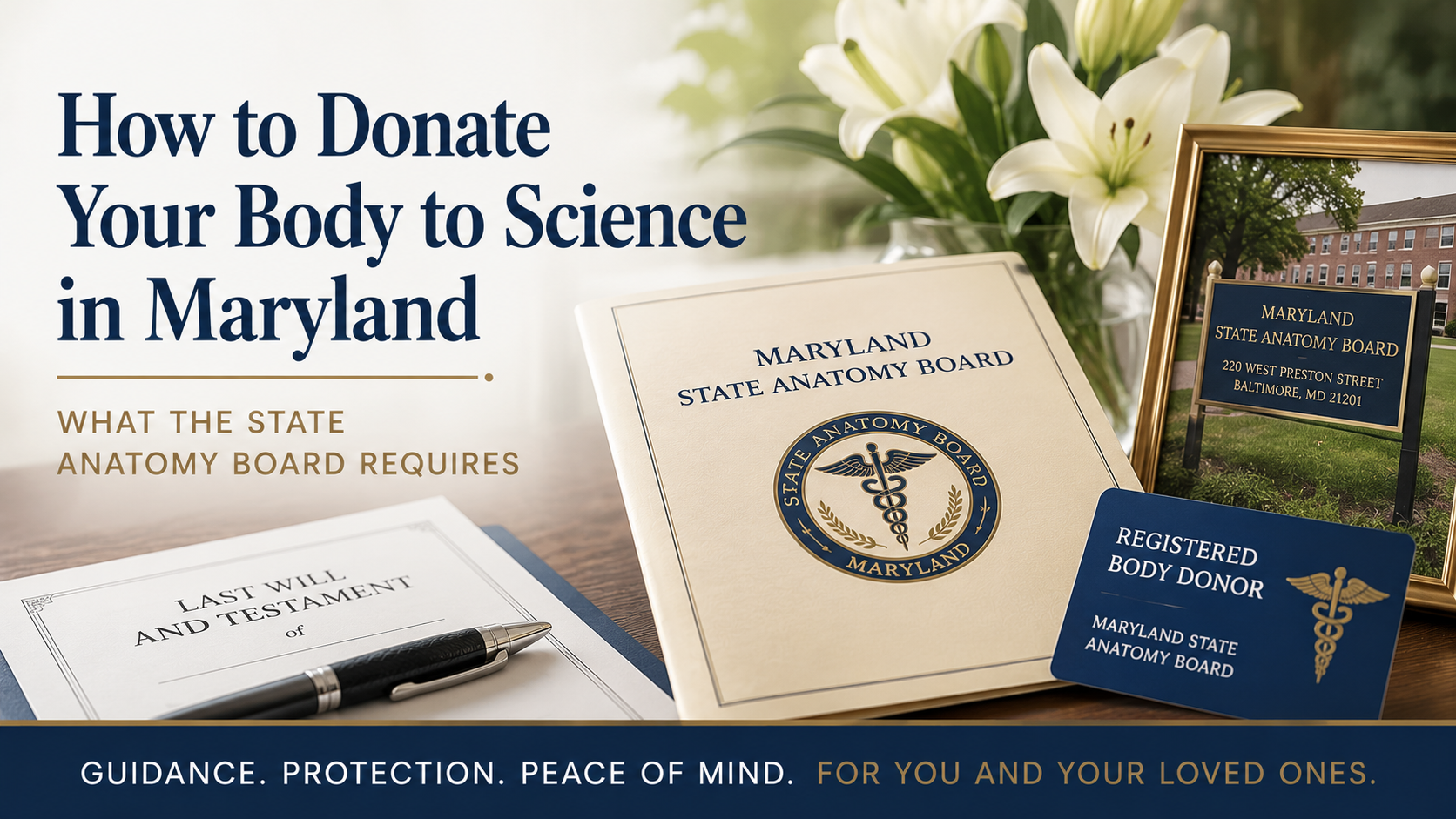
If you want to donate your body to science in Maryland, including the wish in your will is not enough. The Maryland State Anatomy Board has its own registration process, and failing to complete it during your lifetime can prevent your wishes from being carried out. Understanding the difference can spare your family confusion during an already difficult time.
The Maryland State Anatomy Board Is the Only In-State Body Donation Program
Some states have several body-donation programs to choose from, with different universities and even private companies each setting their own rules. Maryland keeps it simple: every medical school, dental school, and health science program in the state receives its donated bodies through one place – the State Anatomy Board. If you live in Maryland and want to donate your body to science, the State Anatomy Board is essentially the only in-state program to register with.
Why a Will Alone Cannot Donate Your Body to Science
Here’s the part that catches families off guard. Maryland law does allow an anatomical gift to be made in a will, and it allows the same intent to be stated in an advance directive. Both are legally valid ways of expressing that wish.
But the State Anatomy Board doesn’t treat either one as registration in its program. A line in a will or a general statement in an advance directive is read as an expression of intent – not as enrollment. To actually become a donor, the Board requires its own signed form, completed while the person is still alive.
There’s a practical reason behind this, beyond bureaucratic preference. A will is often not read until after the funeral has already happened. By the time anyone finds the donation clause, the decision about what to do with the body has usually already been made. An advance directive fares a little better, since it’s meant to be available in a medical crisis, but it still isn’t the form the Board requires to register a donor.
How to Register as a Body Donor in Maryland
A Maryland resident who is at least 18 years old can enroll in the body donation program by completing the Board’s registration form. The form asks for a next-of-kin or designee, and it asks the donor to choose in advance what happens to the cremated remains once the Board’s work is done.
Two adults must witness the signature, and one of them can’t have a financial interest in the donor’s estate. The signed original goes in the mail to the Board’s Baltimore office (a scanned copy, fax, or email won’t be accepted). Registration takes effect the day the Board receives the signed form, and the Board typically mails back a confirmation letter and donor card within about a month.
Registering isn’t complicated, but donors themselves – not an attorney, not a will, not an advance directive – must complete the proper forms while still alive.
Once the registration process is complete, many people naturally ask another question: why choose body donation in the first place? For some families, the decision is driven by a desire to support medical education. For others, the practical and financial benefits also play an important role.
Benefits of Donating Your Body to Science
Donating your body to science in Maryland means no funeral costs. The State Anatomy Board pays for transportation, preparation, and cremation for any resident who dies in-state as a registered donor, and the family pays nothing.
Compare that with a traditional funeral (embalming, cremation, burial, casket, transportation, paperwork, etc.) which can cost anywhere from about $6,000 to $20,000.
Donating also comes with a few other benefits:
- It spares your family from making hard decisions while they’re still grieving, since the choice was already made, in writing, years earlier.
- It doesn’t rule out organ donation. If a donor’s organs are medically suitable for transplant, that recovery happens first, and the two programs work together instead of competing for the same gift.
- It’s genuinely needed. Nationally, fewer than 1 percent of the roughly 2.7 million Americans who die each year become body donors, even though medical schools and research programs consistently need more bodies than they receive.
What Happens After Your Body Is Donated?
Once the Board’s use of the body concludes, usually within a year, the Board cremates the remains. The donor decides in advance where the remains go, either back to a family member named on the registration form or to the Board’s own burial site in Sykesville.
Each June, the Board also holds a memorial service and invites the donor’s family to attend. Live music plays, faith leaders from different traditions speak, and medical students who spent the year learning anatomy from donated bodies describe what the gift meant to their education. For many families, it’s the first time they hear, in detail, how needed and appreciated their loved one’s body truly was.
The Bottom Line for Maryland Families
The mother in the opening wasn’t wrong to believe Maryland law would honor her intent to give her body to medical science. What she missed was one small detail: a clause in her will wasn’t enough. A single form, signed and mailed while she was still living, would have done what her will alone could not.
Estate planning is about more than distributing property. It is also about making sure your personal wishes can actually be carried out. If body donation is important to you, completing the proper registration with the Maryland State Anatomy Board is just as important as documenting your wishes in your estate planning documents.
Taking both steps now can provide clarity for your loved ones and help ensure your final wishes are honored.